One Italian in seven uses AI before buying, and those who do give it the same weight as Google: Netcomm’s 2026 data
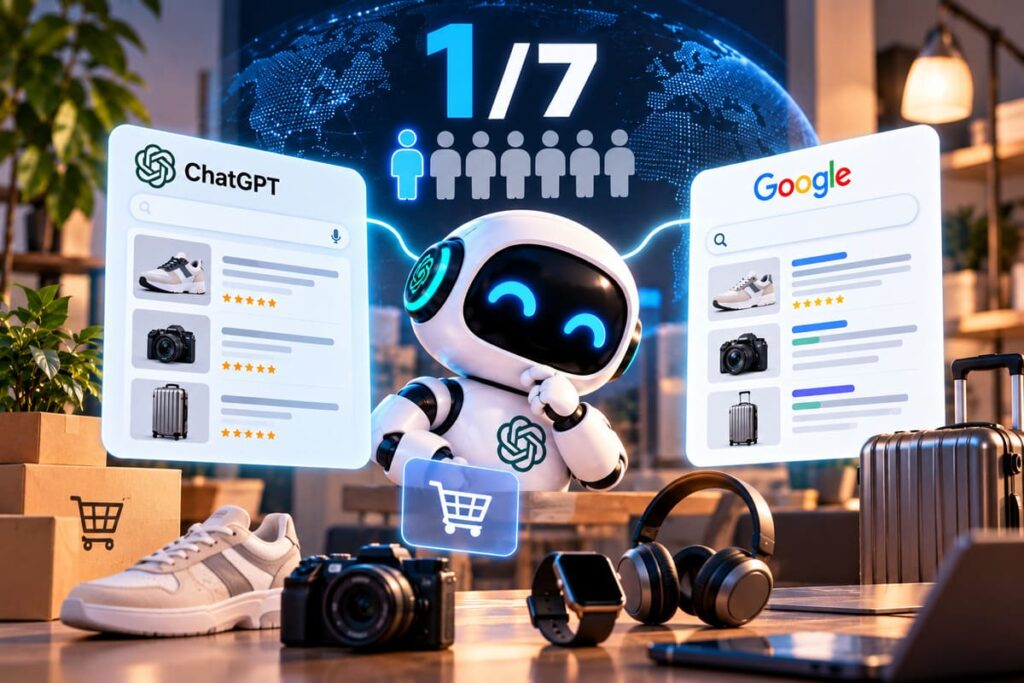
In 2026, 35 million Italians shop online. 13.5% use AI before buying, to compare prices, get product suggestions, and summarize reviews, and those who use it rate it as decisive as the search engine. In the United States, 61 million people start their research with an AI assistant. Netcomm's October 21 data and the PYMNTS study, read for anyone who runs a brand.
In brief
- In 2026, 35 million Italians shop online and spend 66.6 billion euros. 13.5% of product buyers use AI before purchasing, to compare prices, get product suggestions, and summarize reviews. For travel, the share rises to 26.6%.
- AI is the least-used touchpoint before a purchase, but those who use it rate it decisive in 26.6% of cases: the same weight as the search engine, more than reviews and social media. In the United States, 61 million people start their product research with an AI assistant.
- The three things customers ask AI for depend on what a brand publishes: readable prices, clear product pages, reviews. The store remains where 96% of the value is closed, but the choice increasingly starts somewhere else.
On October 21, 2026, Netcomm, the Italian digital commerce consortium, presented its data on how Italians shop in Milan. Among those numbers, one matters more than the others for anyone who runs a brand: one online shopper in seven uses AI before buying, and those who do give it the same weight as Google. We set those numbers alongside the May report on the market, an American study released a few days earlier, and data from a site we run.
Index
The market: 35 million shoppers, 4 touchpoints each
The starting figures come from the May report by Netcomm and the Politecnico di Milano: in 2026, Italians’ online purchases exceed 66.6 billion euros, up 6% on 2025, with 42.6 billion for products and 24 for services. Online shoppers number 35 million, 82% of internet users, with an average age of 48, the same as the population. Before buying, they consult an average of four touchpoints: search engines, brand sites, reviews, comparison sites, social media, notifications, retail media. And as of this year, for some of them, an AI assistant.
How far AI has entered shopping
The data presented at the Netcomm Focus Digital Marketing on October 21 line up three numbers. 35.9% of Italian adults online regularly use at least one AI tool, and among 18-to-34-year-olds the share is 49%. 13.5% of online product buyers use AI before purchasing. For travel, where there are more choices to make, the share doubles to 26.6%.
The most interesting figure for brands is not so much how many people use AI, but what they use it for. 67% use it to compare prices, 66.8% to get product suggestions, and 61.2% to summarize reviews. These are tasks that, until recently, consumers handled on their own, visiting sites, comparing offers, and reading opinions. Today, more and more often, they hand that work over to artificial intelligence. Netcomm sums up the change in one effective sentence: the consumer is starting to delegate to AI. And that is exactly the point: AI does not just help consumers with their research; it becomes an intermediary that selects, compares, and suggests, shaping the path that leads to the purchase decision.
Few use it, but it weighs as much as Google
The most useful figure compares, for each touchpoint, how many people use it and how many, among those who use it, consider it decisive for their choice. The search engine is used by 56% of shoppers and rated decisive by 26.5%; the brand’s site or app 50.5% and 27.5%; reviews 48.2% and 26%; comparison sites 39.2% and 31.4%; social media 31.8% and 19.5%; notifications 30.5% and 26.1%; retail media 25.4% and 18.7%. Chatbots and AI: used by 13.5%, rated decisive by 26.6%.
Read this way, the number changes face. By reach, AI is the last of the touchpoints. By weight on the decision, among those who use it, it stands level with the search engine, above reviews and social media, below only comparison sites and the brand’s own site. Netcomm’s comment is a single line: “using a touchpoint does not mean it counts.” For AI the opposite holds: few use it, but when it is in the journey, it counts.
A figure from another source says the same thing from the trust side. According to a Trustpilot survey of Italian consumers, only 7% would trust an AI recommendation and 30% prefer to check online reviews first, figures presented by Christian Setti at Forum Banca. Few trust blindly, many verify; and 61.2% of those who use AI to shop use it precisely to summarize the reviews they would otherwise go and read.
In the United States, discovery has already changed, purchasing has not
On October 13, PYMNTS Intelligence, an American research firm, published a study based on 2,191 adults surveyed in August in the United States: nearly 61 million consumers, 23%, start their online product research with an AI assistant. 59% of those who use AI to shop look up with AI products they used to search for on Amazon, and 45% have discovered stores they did not know. But only 27% buy from Amazon less often: a 32-point gap between where people search and where they pay. Quarterly spending by AI-assisted shoppers rose to $1,039, up 17%.
The picture is the same as the Italian one, with higher adoption: AI is shifting discovery, not yet the purchase. Sellers had already seen it from their side: Target’s traffic from AI platforms grew twentyfold in a year, and the payment networks are building the protocols for the day when the agent will do the paying. Netcomm, in its May report, puts it cautiously: Agentic Commerce is “a relevant evolutionary direction,” “not yet fully operational in the Italian market.” For a brand, that caution is good news: this is the right time to move. Whoever fixes prices, product pages, and reviews today gets there before the game really starts, and finds the others still standing still.
The store stays central, but the choice starts elsewhere
The same data show where the money ends up: 96% of the value of the 260 retail chains analyzed by Netcomm, 165 billion in purchases in 2024, still goes through physical stores, 4 euros in 100 online. But the journey is already split in two: 40% of in-store purchases are steered by a digital touchpoint, 20% of online purchases mature after a store visit, 30% of in-store shoppers use their smartphone while doing so. And the chains are not keeping pace: their score for blending physical and digital is 3.74 out of 10, and falling, with in-store pickup offered by 58.4% and in-store returns by 35.1%.
In this journey, AI is one more point where the choice forms far from the checkout. On quotidianomotori.com, the online motoring daily we run, 1,337 human visits arrived from AI assistants in 120 days, 984 of them from ChatGPT: small numbers, but these are people who asked a model before opening a website. The store, or the site, receives a decision that has already been made.
What changes for a brand
The three things customers ask AI for, prices, suggestions, and reviews, have one thing in common: they depend on what the brand publishes. A model compares the prices it finds written in plain sight, suggests the products whose pages it can read in full, and summarizes the reviews that exist. For shopping, OpenAI says so itself: product cards are built from structured metadata supplied by sellers and intermediaries, and the review summaries are written by the model from public reviews. So the first thing to do is the most concrete: prices, availability, and descriptions a machine can read, and real reviews, enough of them for a summary to make sense.
The second is to measure the 13.5% in your own industry. For travel it is already 26.6%; for a car, an appliance, or an insurance policy the number is different, and it can be estimated by asking a model the questions customers actually ask and seeing who gets recommended. The third is not to confuse the two numbers: 13.5% says how many people use AI today, the 26.6% relevance figure says how much it counts for those who do. The first grows with adoption, and the American study shows where it can go; the second is already high, and it says that when AI recommends, the customer listens.
Frequently asked questions
According to the Netcomm NetRetail 2026 data presented on October 21, 2026, 13.5% of online product buyers use AI before purchasing; for travel the share is 26.6%. More broadly, 35.9% of Italian adults online regularly use at least one AI tool, and 49% of those aged 18 to 34.
To compare prices (67%), to get product suggestions (66.8%), and to summarize reviews (61.2%), according to Netcomm’s 2026 data. These are the three tasks a model performs on the content published by brands and sellers: prices, product pages, and reviews.
Among those who use it before buying, 26.6% rate it decisive for their choice: the same weight as the search engine (26.5%), more than reviews (26%) and social media (19.5%), less than comparison sites (31.4%) and the brand’s own site (27.5%). It is the least widespread touchpoint, but among the most influential once it enters the journey.
